

Canadian citizenship - IRCC
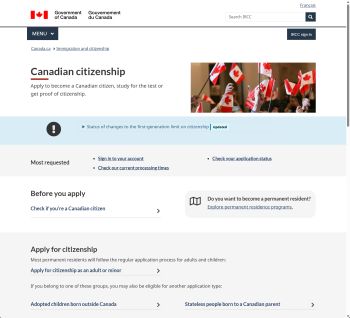
This official IRCC resource explains all major pathways and services related to Canadian citizenship. It covers eligibility criteria, how to apply (online or paper), taking the citizenship test, obtaining proof of citizenship, resuming or giving up citizenship, and changes to rules such as the first-generation limit by descent.
Eligibility for citizenship
To apply, you must be a permanent resident (PR) and meet minimum physical presence in Canada: at least 1,095 days (three years) in the last five years before the day you sign the application. Some days spent as a temporary resident or protected person may count at half-rate, up to a limit. You must also meet other requirements: for adults aged 18-54, language in English or French at CLB 4 (or equivalent) and the citizenship test covering rights, responsibilities and knowledge of Canada. You must have filed taxes for at least three years if required and must not be under a prohibition (for example criminal or security grounds). Minor-specific rules apply for children under 18.
How to apply and process
You can apply online if eligible; paper application remains for some cases (children, special categories, certificate of citizenship for proof). You must submit the correct forms, pay fees and provide supporting documents (proof of PR status, language/test results, travel history accounting days in Canada, tax filing record). IRCC maintains an online status tool to track your application after you receive the acknowledgement of receipt (AOR).
There’s also the requirement to take the oath of citizenship at a ceremony once your application is approved; this completes the process of becoming a Canadian citizen.
Proof of citizenship, restoration and renunciation
Once you are a Canadian citizen you may need proof of citizenship (certificate) to apply for a passport or for other official purposes. If you renounce your citizenship (choose to give it up) or have lost it under specific rules, this page explains the steps. Changes in law – for example the “first-generation limit” for children born abroad – are also summarised.
Practical considerations
- Keep a detailed record of your travel history, days spent inside and outside Canada, and status changes; errors may delay or cause refusal.
- Meeting the 1,095-day requirement does not guarantee citizenship—language/test components and admissibility factors must also be satisfied.
- If you have unmet tax filing obligations or unresolved PR conditions, you may not apply yet.
- Online application is faster and preferred for many adult applicants, but ensure you are eligible for the online route.
- The citizenship test and ceremony are mandatory for most adults 18-54; prepare accordingly.
- Monitoring processing times and your status through your IRCC account helps manage expectations.
Why it matters
Obtaining Canadian citizenship is a landmark change—offering full political rights (e.g., vote, run for office), greater stability and mobility. However, the process involves multiple steps and ongoing compliance; this official page is a trusted starting point for anyone considering becoming a Canadian citizen or seeking proof of their current citizenship status.


'%20fill='white'/%3e%3c/svg%3e)


